![[personal profile]](https://www.dreamwidth.org/img/silk/identity/user.png)
Nov. 12th, 2018 03:42 am
Quest for Memories

The word "Bughouse" appeared in the US in the 1880s and literally means a psychiatric clinic. This is a slang word. It also has similar concepts - turmoil, madhouse, mental hospital. This is not the own name of the game.
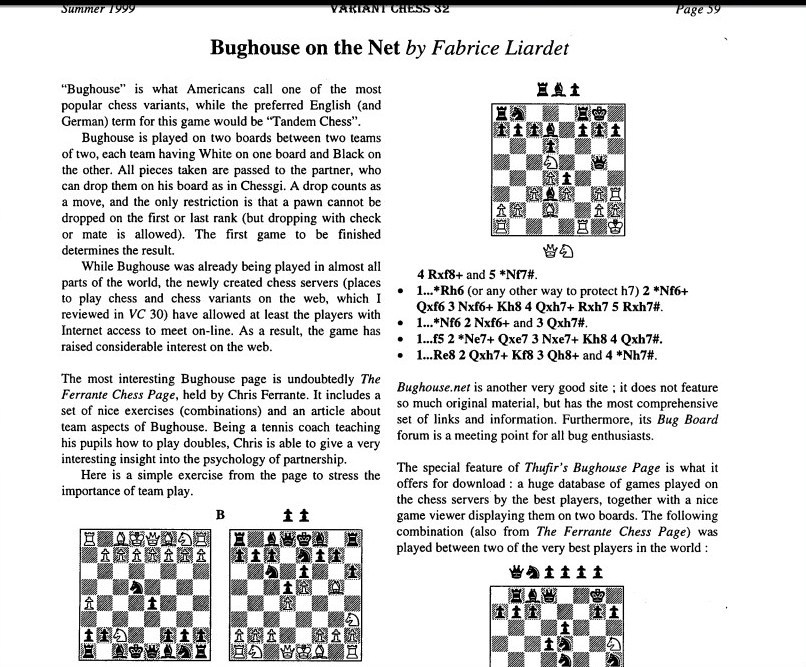
Magazine Chess Variants published by Pritchard and like-minded people represents often other editions of articles about chess variants.
We can not talk about "history" Bughouse chess - there are some facts. We will look for it, but we will find the same information. Their source - "The Encyclopedia of Chess Variants" by David Pritchard

I am aware of the existence of two Bughouse newsletters.
I found a mention of the New England Double Bughouse Chess in the Chess Periodicals: An Annotated International Bibliography, 1836–2008 page 305
New England Double Bughouse Chess Association Journal (19??–1973?)
It was published by Stephen Dann. My friend from U.K gave him my questions. I was interested in what was in his newsletter. I also asked questions about how widespread this game was. And how it was perceived.
He reported that his journal was never digitized.
«Every chess variant does help promote the Royal Game. Few of my chess blogs, publications or 40 years of Sunday chess columns have been digitized.»
He said he played at Northeastern University in Boston 1969-74. He also answered the question about the popularity and perception of the game.
«It was a foolish pastime we did between classes and during activity periods in college. We played on 2-4 boards, single bughouse was too boring as it was all about weird tactics in team 5-minute chess. You won material from weaker players and you attacked f2 and f7 and then there were waitouts. You wreaked a lot of clocks and sets, and we used paper boards. Amateur players beat masters who had weak team members. I really don't know what was so much fun other than you could say anything you wished to say as long as it was related to chess. Rules on pawn promotions were completely weird. Bishops were only good to sac on the long diagonal and you tried to promote to Bishops so you could get 4-5 of the same color so you could get an express train going to keep your opponent in check or threaten a smothered mate. Just winning pawns was enough to end most games. Winning knights ended most games quickly, and like most speed, losers would have to get up.»
Most people who played the bug in the 60s say something like that. The history of the game in the United States is the history of American campuses.
One of the earliest mentions of the game in «The Alumnus» 1970 University of Massachusetts at Amherst.

We all know that Bughouse is game-trap.This is his concept. I think the game had fans and opponents.
Its mass distribution in America - starting from school. But at the same time, unlike silly casual entertainment, the game is not documented anywhere.
Photo from The Hatter 1995 – Stetson University, Yearbook

The second bulletin Bughouse published in the 90s Jerry Graham. He has his own blog.
He said that had distributed all copies of his newsletter.
According to him «…the first bughouse rating system in the US was started by two players from the New York City area, Kantor and Cullen. I operated the rating system for several years in the 90s.One milestone in American bughouse was when the Kaissa digital clocks first came out, and Wesley Ward and Robert Dodge of Philadelphia pioneered the now common timing strategies. Myself and my friend Ron Young also won several bughouse tournaments around then, including the Amateur Team East. From those times on, Philadelphia and Atlanta Georgia players have been some of the dominant ones.»
Of course, we are talking about what happened before the Internet.
Write game history online tried Anders Ebenfelt.
This is a rare and valuable document of the time.
But the very first mention of the game occurred even before the publication of the first books of Pritchard.
A simple search in Google books gives a link to the book «The official blue book and encyclopedia of chess» Kenneth Harkness 1956
It is strange that the creators of the article on Wikipedia did not find this.